QMS, CMMS, EMI, and connected worker software: the fight for the same shop floor
Three systems built around the same shop floor event, and none of them had to answer to the others. A connected worker platform finally answers to all three.
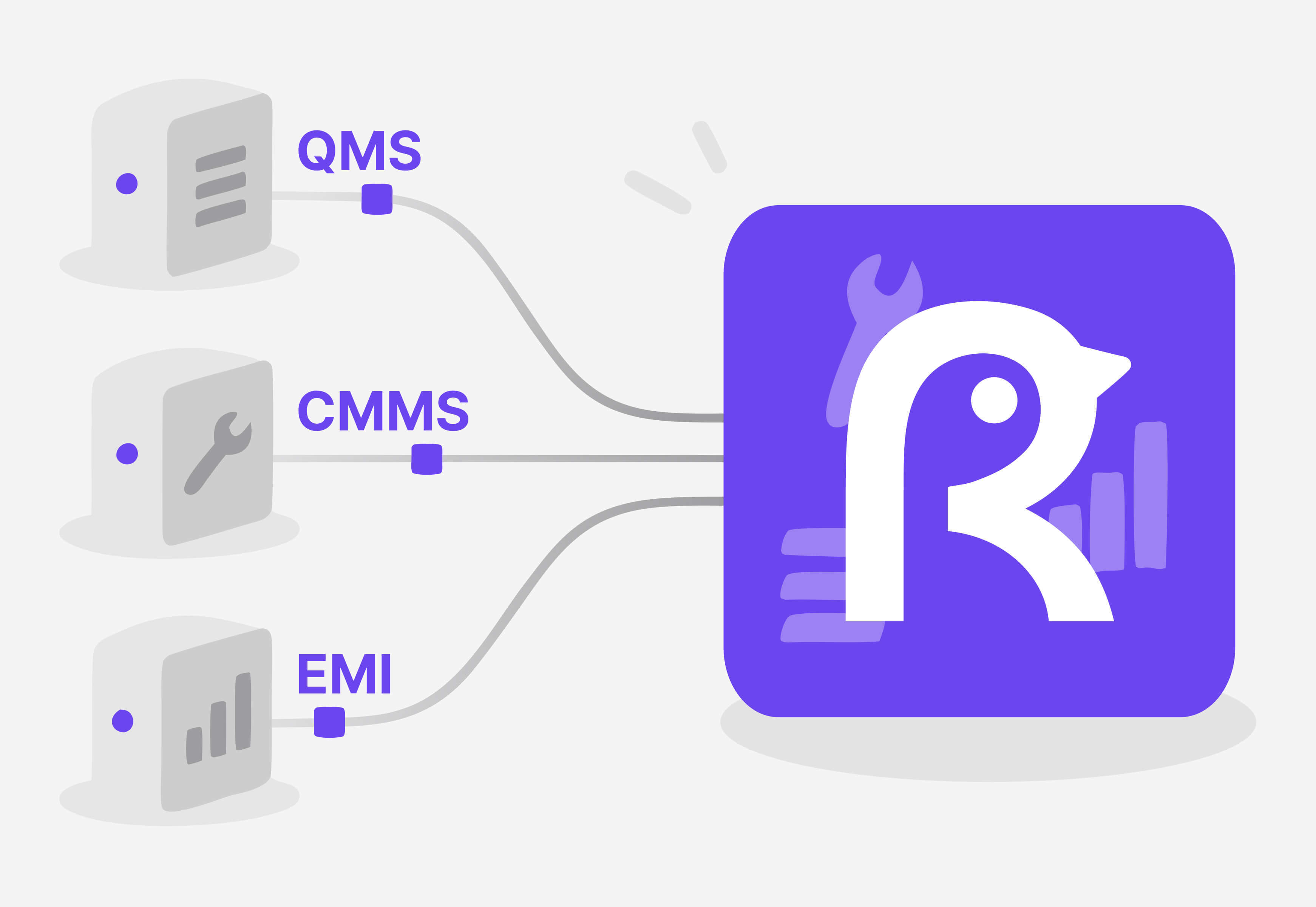

A filling line stops for ninety seconds. Somewhere in that stop is a quality deviation, because a batch parameter drifted out of range. It's also a maintenance event, because whatever caused the drift will need a work order eventually. And it's a downtime record, because someone, somewhere, is trying to calculate today's OEE.
Three systems want to know about the same ninety seconds. Historically, that has meant three databases, three logins, and three different reason-code taxonomies for describing the same stop. Most operators solve this the straightforward way: they enter it once, in whichever system is fastest to open, and let the other two go unfilled.
QMS, CMMS, and EMI were all designed around this same kind of event, just from a different angle. Each one answers to a different person: a QA director, a maintenance manager, a plant director. None of them were built to serve the other two. Instead, they get in each other's way. A connected worker platform (CWP) is built around the person standing in the middle of all three, not around any one of the three systems.
What a QMS is: built for the auditor, not the operator
A Quality Management System (QMS) exists simply because regulators asked for one. ISO 9000, published in 1987, and the FDA's 21 CFR Part 11, finalized in 1997, turned quality documentation from an internal best practice into a compliance obligation regulators could inspect. Vendors then built businesses around that obligation: document control, nonconformance tracking, CAPA workflows. All of it existed to produce one thing: an audit trail.
Notice who that serves. The buyer is the QA director, and the deliverable is a document that satisfies an auditor. The operator on the floor has to type the data in, but they're not who the system was designed for.
That mismatch has a direct consequence. A QMS can't tell you what caused the machine to drift in the first place, that's a maintenance question, or whether the line has actually been running worse this month, that's a performance question. The system was never built to answer either one.
What a CMMS is: playing catch-up with the technician
A Computerized Maintenance Management System (CMMS) exists because equipment fails, and someone has to keep track of what broke, who fixed it, and when it'll break again. It's a maintenance system built for the manager running the reports. The category started on mainframes in the 1980s, got formalized into plant-wide asset management software in the 1990s, and then reborn after 2015 when SaaS, mobile-first tools took over.
That newer generation changed who the software is actually for. These tools still track the same repair history a CMMS always has, but they built the everyday experience around a different person: the technician standing at the machine. That's real progress, and it's an early signal of what a connected worker platform does more completely. But it's progress inside maintenance only, and nothing about a CMMS reaches past its own walls.
Whichever generation of CMMS you're running, it still won't tell you whether the stop that caused the failure ever got logged as a quality deviation, or how that failure feeds into this month's OEE number. A CMMS was never built to answer either one.
What EMI is: the odd one out that never got its own category
Enterprise manufacturing intelligence, or EMI, is the odd one out. LNS Research traces it, also called operations intelligence, back to the early 2000s: a reporting layer built to sit between plant historians, the systems that log raw machine data, and the systems the business actually runs on. It's built for the plant manager or the executive reading the report, not the operator standing at the machine.
EMI never turned into a category that buyers evaluate on its own. Without a proper system of record, there's no dataset that belongs to EMI the way a QMS owns its audit trail or a CMMS owns its repair history, so nothing forces it into its own line item in a budget. Instead, it keeps landing inside whatever tool actually owns the underlying data, most often a manufacturing operations management platform. That's the practical reason the label never stuck: there's no specific piece of software anyone points to and calls the EMI system, the way there is for QMS or CMMS.
Whichever platform ends up hosting EMI, it still doesn't help the operator standing at the line when the stop happens. EMI can tell you the line ran worse this month, in a report someone reads at a desk days or weeks later. It can't tell the operator what to do in the moment, and by the time that report reaches someone with the authority to act on it, the person who actually knows why the line slowed down has moved on to the next shift, and the real cause is already going cold.
Where connected worker platforms fit: grouped by person, not by function
A connected worker platform (CWP) is the response to that exact gap. Instead of grouping software by function like the other three, quality, maintenance, reporting, it groups software by person. LNS Research calls this category Connected Frontline Workforce (CFW) and frames it as six capabilities:
- Digital knowledge management
- Work execution support
- Competency management
- Workforce analytics
- Team collaboration
- Persona-based use cases
CWPs are further along than the hype suggests. Gartner tracks the same category under its own name, Connected Factory Worker, and its 2025 Hype Cycle for Manufacturing Operations Strategy already counts real, proven use in manufacturing plants, not just pilots and promises.
CWP inherited one real weakness from EMI: it has no system of record of its own either. Most implementations end up pulling data in from other transactional systems, MES chief among them, because no single CWP vendor covers every use case on its own. Multi-vendor architectures are the norm here, the same way EMI never got to stand alone.
How CWP closes the gap: one entry, three systems
Go back to the ninety-second stop. A QMS wants it logged as a deviation. A CMMS wants it logged as a work order. EMI wants it folded into this month's OEE number. Historically, that meant the operator picked one system to satisfy and let the other two lapse, not out of laziness, but because nobody had built a version of this where one entry could satisfy all three.
That's the actual gap CWP fills, without replacing the older systems' underlying logic: a deviation still needs to reach the QMS, a failure still needs to reach the CMMS, and the stop itself still needs to reach this month's OEE number. Built around the person doing the work instead of the report about it, a connected worker platform captures the stop once, at the point of work, and routes it to whichever systems need it, instead of asking one person to be three separate data-entry clerks in the same ninety seconds.
Where Factbird fits: correlation, not just faster forms
A connected worker platform gets that one entry to reach all three systems. Our Connected Worker layer does that too, and then asks a different question: where does that entry come from in the first place?
Most connected worker platforms, ours included, help standardize what an operator sees and does during a shift: guided workflows, paperless quality checks, digital work instructions, a way to flag a problem before it becomes a bigger one.
Where we differ is what feeds that experience in the first place. A lot of connected worker platforms run on self-reported input. A better interface on top of a manual form is still a manual form. Our layer starts with data pulled directly from the equipment, nothing is typed in after the fact. That's what makes correlation possible. Each system gets more than an entry: it gets a reason.
A quality check tied to the batch that produced it, so the QMS gets a deviation with a cause attached instead of just a note. A downtime event tied to the activity that caused it, so the CMMS gets a work order that isn't starting from zero. An SOP execution tied to the OEE delta that followed it, so EMI gets the reason the number moved, not just confirmation that it did.
At first glance, it might look like a small change. In practice, however, manufacturers running Connected Worker on top of that correlation see a further 3-point OEE uplift and a 20% productivity gain, across a sample of 19 lines. It's the difference between software that trusts what the operator remembers about the stop, and software that already knows what happened before anyone opens the app.